
Legacy Lab

Honouring the wisdom and legacy of eldership and supporting flourishing throughout the lifespan. Recognising the importance of intergenerational stories and that sustainable wellbeing arises when our choices align with ecological, cultural, economic, and human needs across time.

About this Lab:

The Legacy Lab explores how individuals, communities, and institutions can act with long term responsibility for future generations. ESF emphasises that flourishing is inherently intergenerational and that sustainable wellbeing arises when our choices align with ecological, cultural, economic, and human needs across time .

This Lab strengthens the capacities required for foresight, stewardship, and values led leadership. It supports initiatives that help communities articulate their long term aims, cultivate coherence between present actions and future consequences, and embed practices that protect what matters most. The Legacy Lab ensures that today’s decisions contribute to a thriving world for those yet to come.

Entry Questions:
  • How can elders and young people learn and grow together?
  • What creates meaning, dignity, and connection in later life?
  • How are we nurturing the inner life of caregivers?
  • How are we holding and honouring the importance of the end of life?

Present examples of how care settings can nurture and enhance the wellbeing of everyone involved

[CTA Notes:] Leading to Innovation Lab expression of interest
Button
Button
Resources

Open Resources for Change

Powerpoint
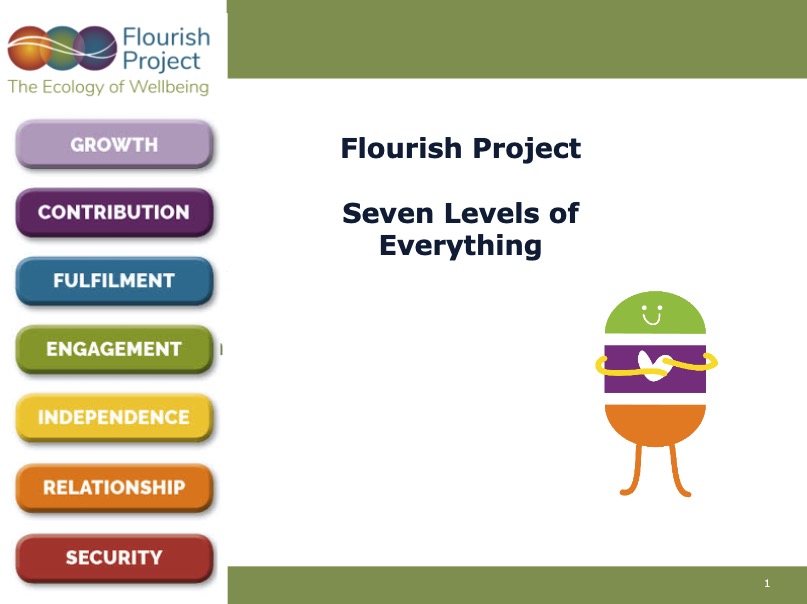
Seven Levels of Everything
The document outlines the Flourish Project's 'Seven Levels of Everything' model, a holistic framework for wellbeing applicable to individuals, communities, schools, and care settings. The seven levels—Growth, Contribution, Fulfilment, Engagement, Independence, Relationship, and Security—are each explored through reflective questions and linked to practical needs and resources for different groups. The model emphasizes human rights, personal and community development, emotional and physical health, and environmental sustainability. It connects to international wellbeing measures, educational competencies, and care frameworks, highlighting values such as empathy, resilience, creativity, inclusiveness, and safety. The document also provides examples of community resources, wellbeing apps, and care approaches (including Montessori and dementia care) that align with the seven levels, aiming to support holistic flourishing across all life stages and societal levels.
Download Resource
Word Document
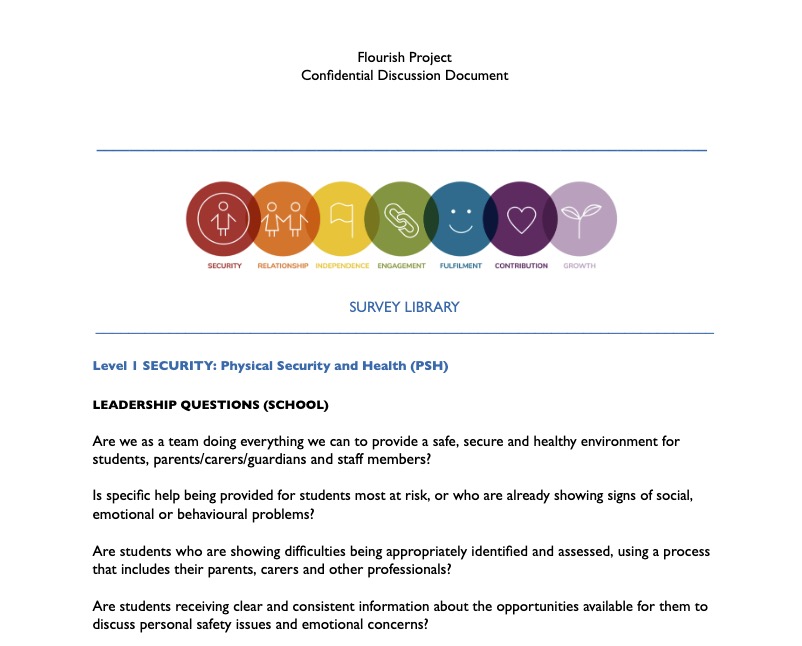
Digital Wellbeing Platform - Survey Library
The document is a survey library for schools aimed at assessing and promoting wellbeing among students, staff, parents/carers/guardians, and leadership. It is organized around seven key themes: Security, Relationship, Independence, Engagement, Fulfilment, Contribution, and Growth. Each theme includes targeted questions for different stakeholders to evaluate experiences and perceptions related to safety, mental health, relationships, self-worth, engagement, fulfilment, participation, and sense of purpose. The purpose is to help schools identify strengths and areas for improvement in wellbeing, fostering a supportive and inclusive environment for the entire school community.
Download Resource
Word Document
The ESF Wellbeing Evaluation Grades
The document describes the Eco-Systemic Flourishing (ESF) Grading System, which assesses wellbeing frameworks based on two main criteria: the depth of human motivation (across seven levels) and the breadth of ecosystemic integration (across four domains: Human Capacities & Potential, Cultural Values & Identity, Natural Environment, and Circular & Regenerative Economics). Frameworks are evaluated on five dimensions—Motivational Depth, Domain Breadth, Relational Integration, Ecological Consciousness, and Transformative Potential—each scored from 0 to 5, for a maximum of 25 points. Grades range from A (fully integrated, eco-systemic) to E (minimal integration). The system is applied to various frameworks, noting that Nova Scotia Community Wellbeing scores highly for participatory and ecological integration, while British Columbia Health Indicators is strong in basic needs but lacks growth and ecological focus. The document emphasizes the value of participatory, adaptive, and ecological approaches for higher ESF grades and suggests Nova Scotia could serve as a global model with further improvements.
Download Resource
Word Document
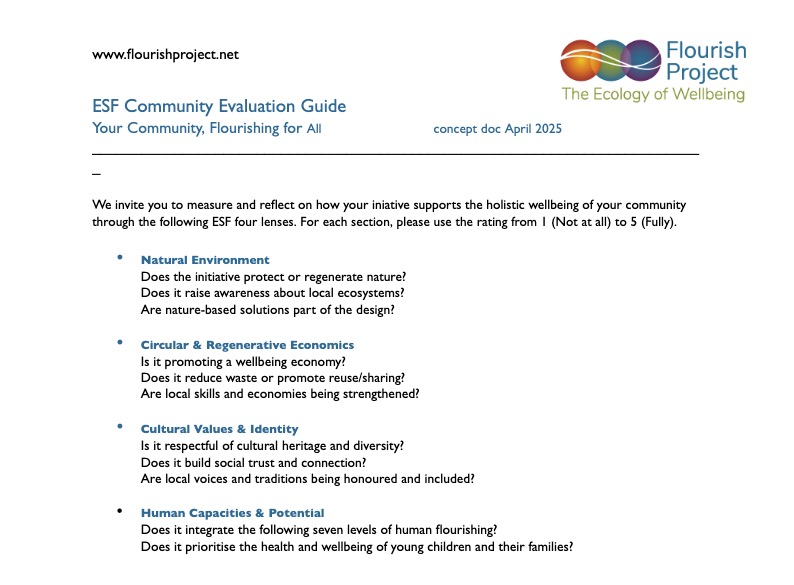
ESF Community Evaluation Guide
The ESF Community Evaluation Guide outlines a framework for assessing community initiatives through four key lenses: Natural Environment (focus on nature protection, ecosystem awareness, and nature-based solutions), Circular & Regenerative Economics (emphasizing wellbeing economies, waste reduction, and support for local skills and economies), Cultural Values & Identity (highlighting heritage, social trust, and inclusion of local voices), and Human Capacities & Potential (covering physical health, emotional safety, agency, meaningful activities, self-expression, participation, and intergenerational learning). The guide recommends rating each area from 1 to 5 to evaluate the initiative's overall impact on holistic community wellbeing.
Download Resource