

Resources
Curabitur blandit tempus porttitor. Curabitur blandit tempus porttitor. Lorem ipsum dolor sit amet, consectetur adipiscing elit. Vestibulum id ligula porta felis euismod semper. Morbi leo risus, porta ac consectetur ac, vestibulum at eros. Cras justo odio, dapibus ac facilisis in, egestas eget quam.
Resources
Open Resources for Change

PDF
Flourish Values Model
The document outlines the Flourish Values Model (FVM) for assessing wellbeing in schools, organized around seven domains: Physical Security and Health, Relational Wellbeing, Resilience and Self-esteem, Positive Involvement and Functioning, Positive Integration and Expression, Social Connection and Self-worth, and Meaning, Purpose and Vitality. Each domain includes specific indicators, datasets, and sample survey questions for students, parents, and staff. The model stresses the importance of safe environments, supportive relationships, personal agency, engagement, self-expression, social participation, and a sense of purpose. It references established wellbeing and resilience measures and provides detailed tools and strategies for schools to evaluate and promote holistic wellbeing among students and staff.
Download Resource
Word Document
Measures of Wellbeing - Nursery Schools
The document presents the Flourish Model for assessing wellbeing in nursery schools, structured around seven levels: Security, Relationship, Independence, Engagement, Fulfilment, Contribution, and Growth. It emphasizes ensuring children's safety, health, and stable home environments; fostering high-quality adult-child interactions; supporting individuality and parental involvement; and promoting independence through play and self-regulation. Engagement is encouraged by aligning activities with children's skills and interests, while fulfilment focuses on happiness, purpose, and achievement. Contribution highlights belonging, empathy, and respect for diversity, and growth involves nurturing passion, cultural understanding, and connection to nature. The document also outlines strategies for supporting the wellbeing of children, staff, and parents, and stresses the importance of smooth transitions to primary education. It suggests using various datasets, such as safeguarding records and measures of happiness and achievement, to monitor wellbeing at each level.
Download Resource
PDF
Measures of Wellbeing
The document outlines the Flourish Model, an ecological wellbeing framework aimed at measuring and promoting wellbeing at individual, family, school, community, care home, city, and national levels. It emphasizes whole-systems thinking, community engagement, and customizable indicators to assess values, strengths, and areas for growth. The model provides tools and surveys for individuals to evaluate wellbeing across seven levels: security, relationship, independence, engagement, fulfilment, contribution, and growth. Families are encouraged to discuss generational values and healthy living, while schools use the model to support students’ holistic development. Communities are guided to identify strengths and address needs through participation and resource mapping. For care homes, the model focuses on dignity, safety, emotional support, and growth for residents and staff. At city and national levels, it supports wellbeing strategies aligned with economic, social, environmental, and cultural indicators, and the UN Sustainable Development Goals. The overall goal is to create environments that foster resilience, values, and collective wellbeing.
Download Resource
Powerpoint
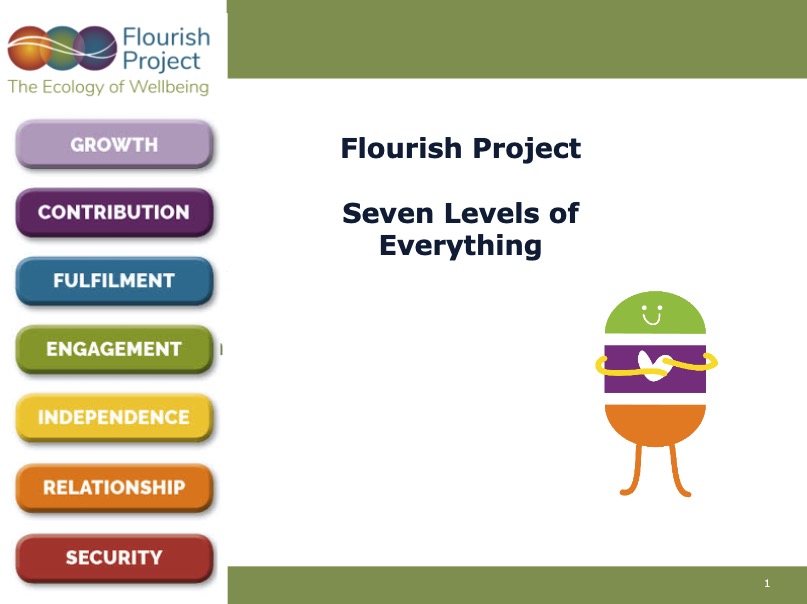
Seven Levels of Everything
The document outlines the Flourish Project's 'Seven Levels of Everything' model, a holistic framework for wellbeing applicable to individuals, communities, schools, and care settings. The seven levels—Growth, Contribution, Fulfilment, Engagement, Independence, Relationship, and Security—are each explored through reflective questions and linked to practical needs and resources for different groups. The model emphasizes human rights, personal and community development, emotional and physical health, and environmental sustainability. It connects to international wellbeing measures, educational competencies, and care frameworks, highlighting values such as empathy, resilience, creativity, inclusiveness, and safety. The document also provides examples of community resources, wellbeing apps, and care approaches (including Montessori and dementia care) that align with the seven levels, aiming to support holistic flourishing across all life stages and societal levels.
Download Resource
PDF
A Comparative Study of Wellbeing Indicators Across Sectors
The document provides a comparative analysis of global wellbeing indicators using the Flourish Model, which organizes wellbeing into seven domains: Security, Relationship, Independence, Engagement, Fulfilment, Contribution, and Growth. It maps various international wellbeing frameworks (such as the Harvard Flourishing Measure, PERMA, NZ Wellbeing Scale, and NEF Five Ways to Wellbeing) to these domains, detailing the types of questions and indicators used to assess wellbeing in schools and communities. Key aspects covered include physical health, safety, relationships, emotional support, self-efficacy, engagement, belonging, life satisfaction, and purpose. The document emphasizes holistic, multi-level approaches that consider individual, family, school, and community factors, and introduces the Flourish Values Model to support community engagement and systemic wellbeing improvement.
Download Resource
PDF
Flourish Values Model - Digital Wellbeing Tool
The document presents the Flourish Values Model, a digital wellbeing assessment tool designed to measure wellbeing across seven areas: Security, Relationship, Independence, Engagement, Fulfilment, Contribution, and Growth. It uses targeted questions for each aspect to help users reflect, identify areas for improvement, and determine support needs. The tool is suitable for individuals, groups, or professionals, offering visual summaries and progress tracking. Its purpose is to encourage meaningful conversations, community engagement, and support both personal and collective wellbeing through structured self-assessment and reflection. Sample questions address safety, relationships, autonomy, daily activities, purpose, community involvement, and personal development.
Download Resource
PDF
City Measures of Success
The document presents a framework for measuring city success through wellbeing, focusing on leadership engagement, funding, service integration, citizen participation, and improvements in wellbeing indicators. It outlines metrics across four domains: Natural Environment (ecological health, air/water quality, pollution, access to nature), Circular & Regenerative Economics (economic health, housing, employment, transport, support services), Cultural Values & Identity (kindness, arts, political expression, religious tolerance, civic participation), and Human Capacities & Potential. The latter is detailed through seven levels of human motivation—Security, Relationship, Independence, Engagement, Fulfilment, Contribution, and Growth—each with specific indicators to assess wellbeing and city success.
Download Resource
PDF
Digital Wellbeing Platform for Cities
The document presents a creative brief for a Digital Wellbeing Platform for Cities designed to integrate global health and wellbeing frameworks, supporting interdisciplinary research and promoting holistic wellbeing across environmental, health, and socio-economic areas. The platform targets municipal governments, urban planners, community stakeholders, educators, NGOs, indigenous populations, and researchers. Key features include integration of diverse wellbeing frameworks, a comprehensive indicator databank aligned with ecological, human, and socio-economic factors, and the Sustainable Development Goals (SDGs). The platform offers customizable dashboards, advanced analytics, decision support tools, and strong search capabilities. Priorities include community engagement, scalability, interoperability, data privacy, stakeholder collaboration, and long-term sustainability. Deliverables encompass a user-friendly digital platform, database, visualization and predictive analytics tools, and ongoing support. The project is phased (R&D, pilot, deployment), with success measured by adoption, wellbeing improvements, SDG alignment, user satisfaction, and cost-effectiveness.
Download Resource
PDF
Digital Wellbeing Platform
The document outlines a draft framework for school wellbeing indicators intended for a digital wellbeing platform. It is organized around seven key themes: Security, Relationship, Independence, Engagement, Fulfilment, Contribution, and Growth. For each theme, the framework provides targeted questions for school leadership, staff, parents/carers/guardians, and students, with optional questions for deeper exploration. The aim is to assess and promote aspects such as safety, emotional support, belonging, confidence, engagement, personal fulfilment, social contribution, and a sense of purpose within the school community. The framework emphasizes inclusive practices, supportive relationships, personal development, and value alignment among all stakeholders to support holistic wellbeing in schools.
Download Resource
Word Document
UK Thriving Places Index Example ESF Evaluation
The document evaluates the UK Thriving Places Index (TPI) using the Eco-Systemic Flourishing (ESF) framework. It finds that the TPI strongly covers economic and structural factors of wellbeing, such as local economy, work, learning, fairness, housing, and transport, and also represents human capacities like health and education. Environmental sustainability is included mainly through ecological condition metrics, with less focus on human-nature relationships. Cultural values and identity are emerging areas, with some indicators of belonging and civic participation but limited attention to cultural heritage and diversity. The analysis identifies gaps in relational indicators (trust, empathy, intergenerational connection), cultural identity, ecological reciprocity, and transformational learning. Recommendations include enhancing relational, cultural, and ecological dimensions, shifting from sustainability to regeneration, and incorporating participatory and narrative data. The TPI is recognized as a sophisticated wellbeing framework but would benefit from broader coverage of relational, cultural, and transformational aspects to support fuller ecosystemic flourishing.
Download Resource
Word Document
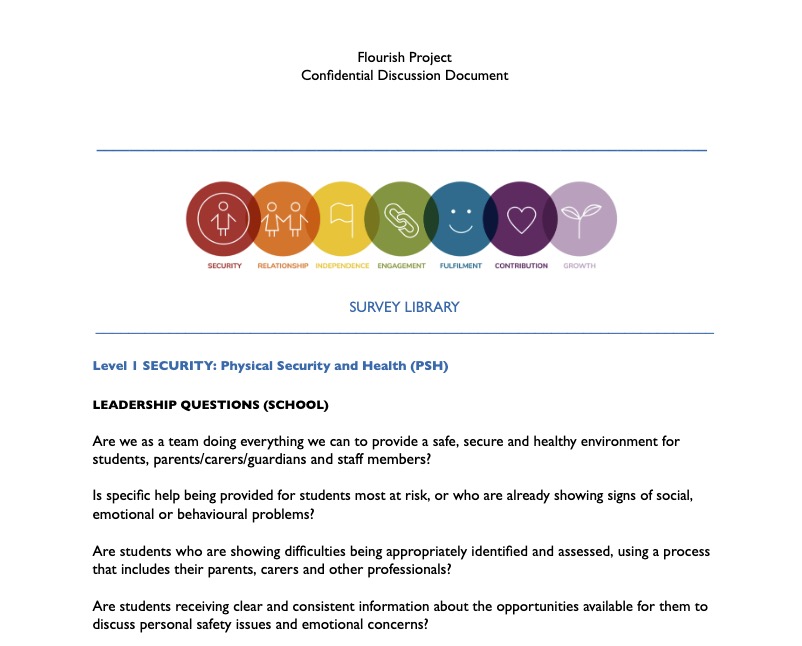
Digital Wellbeing Platform - Survey Library
The document is a survey library for schools aimed at assessing and promoting wellbeing among students, staff, parents/carers/guardians, and leadership. It is organized around seven key themes: Security, Relationship, Independence, Engagement, Fulfilment, Contribution, and Growth. Each theme includes targeted questions for different stakeholders to evaluate experiences and perceptions related to safety, mental health, relationships, self-worth, engagement, fulfilment, participation, and sense of purpose. The purpose is to help schools identify strengths and areas for improvement in wellbeing, fostering a supportive and inclusive environment for the entire school community.
Download Resource
Word Document
The ESF Teacher Evaluation Grading System
The document describes the Eco-Systemic Flourishing (ESF) Teacher Wellbeing Evaluation Grading System, which assesses teacher wellbeing frameworks based on two main dimensions: depth of human motivation (ranging from security to growth) and breadth of ecosystemic integration (including human capacities, cultural values, the natural environment, and regenerative economics). Each framework is scored on five criteria—motivational depth, domain breadth, relational integration, ecological consciousness, and transformative potential—each on a 0-5 scale, for a total of 25 points. Grade bands range from A (fully ecosystemic) to E (minimal integration). The document finds that most existing frameworks focus on individual or relational wellbeing but lack ecological and systemic integration. The ESF framework emphasizes compassion as a central principle and advocates for a shift from individual stress management to systemic flourishing, promoting regenerative design, collaborative governance, and ecological stewardship to support personal, relational, and planetary health in education.
Download Resource
Word Document
UK Beewell Survey Example ESF Evaluation
The document evaluates the UK #BeeWell adolescent survey using the Eco-Systemic Flourishing (ESF) framework. It finds the survey is strong in assessing psychological wellbeing, emotional regulation, self-esteem, resilience, health behaviours, social identity, inclusion, and experiences of discrimination. However, it places less emphasis on economic and ecological aspects, with limited questions on material wellbeing and environmental connection. The survey covers all seven levels of human motivation, particularly Relationship and Security, but is weaker in Growth and Contribution. Noted gaps include ecological connection, civic engagement, intergenerational belonging, and systemic equity. Recommendations are to expand questions on nature, community service, and economic justice, and to better balance personal wellbeing with systemic factors. Overall, the #BeeWell survey is recognized as a leading, child-centred wellbeing tool that could be improved by integrating broader ecological and economic dimensions.
Download Resource

Word Document
The ESF Wellbeing Evaluation Grades
The document describes the Eco-Systemic Flourishing (ESF) Grading System, which assesses wellbeing frameworks based on two main criteria: the depth of human motivation (across seven levels) and the breadth of ecosystemic integration (across four domains: Human Capacities & Potential, Cultural Values & Identity, Natural Environment, and Circular & Regenerative Economics). Frameworks are evaluated on five dimensions—Motivational Depth, Domain Breadth, Relational Integration, Ecological Consciousness, and Transformative Potential—each scored from 0 to 5, for a maximum of 25 points. Grades range from A (fully integrated, eco-systemic) to E (minimal integration). The system is applied to various frameworks, noting that Nova Scotia Community Wellbeing scores highly for participatory and ecological integration, while British Columbia Health Indicators is strong in basic needs but lacks growth and ecological focus. The document emphasizes the value of participatory, adaptive, and ecological approaches for higher ESF grades and suggests Nova Scotia could serve as a global model with further improvements.
Download Resource
Word Document
The ESF Teacher Wellbeing Evaluation Grades
The document presents the Eco-Systemic Flourishing (ESF) Grading System for evaluating teacher wellbeing frameworks. The ESF system assesses frameworks across five dimensions—motivational depth, domain breadth, relational integration, ecological consciousness, and transformative potential—each scored from 0 to 5, for a total of 25 points. Grade bands range from A (fully ecosystemic and integrated) to E (minimal wellbeing integration). Analysis of current frameworks shows most score between C and B-, indicating some eco-systemic awareness but limited ecological and transformative depth. The ESF framework centers compassion, integrating self-care, relational trust, ecological stewardship, and structural fairness. The document concludes that improving teacher wellbeing requires shifting from individual-focused models to ecosystemic approaches that embed compassion and regenerative design throughout education systems, promoting self, relational, and planetary care.
Download Resource
Word Document
Semantic Synthesis Indicators Example ESF Evaluation
The document reviews the Semantic Synthesis Indicators (SSI) framework, which unifies 213 wellbeing frameworks into a comprehensive meta-framework focused on human capacities and potential. It covers health, education, safety, life satisfaction, and economic enablers like employment and sustainable resource use, but lacks metrics for regenerative and circular economies. The natural environment is mainly treated as capital, with limited attention to biodiversity and ecological relationships. Cultural and spiritual identity, heritage, intercultural trust, and Indigenous knowledge are underrepresented. The SSI aligns well with lower-to-mid levels of the Eco-Systemic Flourishing (ESF) model but is weaker in higher-order motivations such as contribution and growth. Key gaps include indicators for ecological reciprocity, regenerative economics, cultural and spiritual identity, and transformative growth. Recommendations include adding modules for ecological belonging, moral development, and relational measures. The SSI is a strong step toward post-GDP wellbeing measurement but needs further development to fully support systemic flourishing across all ESF domains.
Download Resource
Word Document
British Columbia Health Indicators Example ESF Evaluation
The document evaluates British Columbia's health indicators using the Eco-Systemic Flourishing (ESF) framework. It finds that current indicators focus mainly on clinical outcomes, risk behaviors, and basic needs, with strong emphasis on biomedical and economic factors. There is limited measurement of cultural values, social belonging, Indigenous identity, and ecological determinants like air quality and green space access. Higher-order wellbeing aspects such as life satisfaction and community contribution are rarely tracked. The analysis recommends expanding indicators to include social cohesion, cultural participation, environmental exposures, and community resilience. It suggests pairing risk and resource metrics, tracking environmental context, ensuring equity in data, and including relational and community participation measures. The conclusion is that the current system excels at tracking survival and safety but lacks measures for holistic wellbeing, and should evolve to integrate prevention, culture, and ecology as co-determinants of health.
Download Resource
Word Document
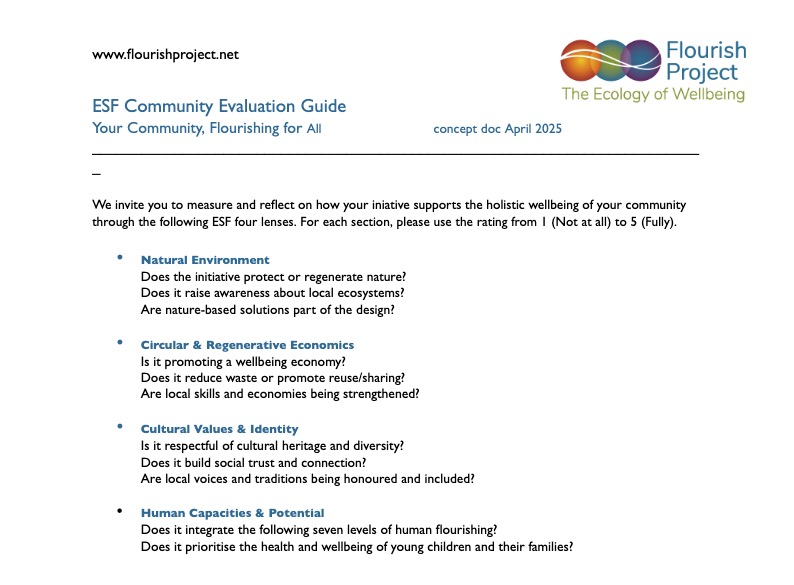
ESF Community Evaluation Guide
The ESF Community Evaluation Guide outlines a framework for assessing community initiatives through four key lenses: Natural Environment (focus on nature protection, ecosystem awareness, and nature-based solutions), Circular & Regenerative Economics (emphasizing wellbeing economies, waste reduction, and support for local skills and economies), Cultural Values & Identity (highlighting heritage, social trust, and inclusion of local voices), and Human Capacities & Potential (covering physical health, emotional safety, agency, meaningful activities, self-expression, participation, and intergenerational learning). The guide recommends rating each area from 1 to 5 to evaluate the initiative's overall impact on holistic community wellbeing.
Download Resource
PDF
ESF Community Evaluation Guide
The ESF Community Evaluation Guide outlines a framework for assessing community initiatives through four key lenses: Natural Environment (focusing on nature protection, ecosystem awareness, and nature-based solutions), Circular & Regenerative Economics (emphasizing wellbeing economies, waste reduction, and support for local skills and economies), Cultural Values & Identity (highlighting respect for heritage, social trust, and inclusion of local voices), and Human Capacities & Potential (covering health, empowerment, meaningful activities, self-expression, participation, and intergenerational learning). Each area is rated on a 1 to 5 scale to encourage reflection on the initiative’s holistic impact.
Download Resource
Word Document
Engage Nova Scotia Quality of Life Indicators Example ESF Evaluation
The document evaluates the Engage Nova Scotia Quality of Life Indicators using the Eco-Systemic Flourishing (ESF) framework. It finds that the framework strongly addresses human capacities (health, education, safety, personal development), economic wellbeing (living standards, housing, work), and is increasingly incorporating cultural values (belonging, inclusion, trust, especially for Mi'kmaq and African Nova Scotian communities) and environmental awareness (connection to nature, stewardship). The survey effectively covers various human motivations, with strengths in security, relationships, and independence, and growing attention to contribution and growth. The initiative is recognized for its participatory approach, large-scale engagement, and transparency. Identified gaps include ecological consciousness, intergenerational wellbeing, systemic resilience, and prosocial contribution. The framework is evolving from a wellbeing dashboard to a holistic, participatory model, with recommendations to further integrate ecological and transformative learning aspects.
Download Resource
PDF
ESF Community Evaluation Leaflet
The ESF Community Evaluation Leaflet outlines a framework for assessing community initiatives in areas such as the natural environment, circular and regenerative economics, cultural values and identity, and human capacities and potential. It employs a rating and comment system to evaluate factors like nature protection, waste reduction, cultural heritage, learning support, and wellbeing. The leaflet introduces the "Seven Levels of Human Flourishing"—physical wellbeing, emotional safety, self-esteem, transformation, meaning, service, and unity—with prompts for evaluation. Its purpose is to guide communities in reflecting on and rating their initiatives' contributions to sustainability and flourishing, using both quantitative and qualitative feedback.
Download Resource
Excel File
ESF Evaluation Indicators
The document presents a framework of evaluation indicators for assessing programs or policies across multiple dimensions: Human (wellbeing, resilience), Relational (care work, knowledge diversity), Ecological (regenerative practices, planetary boundaries), Spiritual (sacredness, meaning-making), and Motivational Spectrum (security, community, autonomy, engagement, fulfilment, contribution, growth). Each indicator is paired with suggested measurement types and metrics, such as content analysis, policy review, thematic coding, and scoring systems. An integrative insight indicator is included to assess coherence across all domains, aiming for a comprehensive, multidimensional evaluation approach.
Download Resource
PDF
Eco-Systemic Flourishing (ESF) Framework - Integrated Wellbeing Evaluation Form
The document outlines the Eco-Systemic Flourishing (ESF) Framework Integrated Wellbeing Evaluation Form, which assesses how global wellbeing measures incorporate four key ESF categories: Natural Environment, Circular and Regenerative Economics, Cultural Values and Identity, and Human Capacities and Potential. It details evaluation criteria and example indicators for each category, such as biodiversity, circular economy practices, cultural heritage, and holistic human development. The form uses a scoring system to rate the integration of these categories and describes a methodology for distributing, collecting, and analyzing responses to identify strengths and gaps. The aim is to guide policy, education, and research toward more holistic and regenerative wellbeing standards worldwide.
Download Resource
Join our newsletter to stay up to date on features and releases
By subscribing you agree to our Privacy Policy