Healing Lab

Global Healing Day is a worldwide call to collective healing - across people, communities and ecosystems. It is a decentralised movement inviting diverse actions, stories and gatherings dedicated to regenerating life on Earth.

About this Lab:

Global Healing Day - April 25, 2026

What if one day each year, humanity paused – together - to honour our pain, celebrate life, and recommit to healing the web

of relationships that sustain us all? Global Healing Day is not just an event. It’s a gathering point, a shared heartbeat for people and organisations around the world who are choosing healing - personal, collective, ecological, and spiritual - as the foundation for a thriving future.

In a time of deep fragmentation, disconnection and inherited trauma, this is a call to co-create something different. A living ecosystem of action and reflection. A day to remember what it means to be in kinship - with each other, the Earth, and all beings. Whether through community circles, interfaith rituals, somatic practices, storytelling, music, film, or ceremony - everyone is invited to contribute in their own way.

🔹 Host or join a local or online event

🔹 Share healing practices from your tradition or community

🔹 Honour grief, offer forgiveness, plant a tree, hold silence

🔹 Reflect on what your family or culture is ready to release—or carry forward

This is not a branded campaign - it is a commons of care, stewarded by many, owned by none.

Join us on April 25 and help seed a new rhythm of global coherence and regenerative action. Together, we can shift

systems, rewrite stories, and restore the deep code of belonging.

One humanity. One Earth. Many paths. One intention.

To get involved, share your plans or join the global partner network, visit:

www.globalhealingday.world
Button
Resources

Open Resources for Change

PDF
Introducing the ESF Framework - Flourish Project, Sept 2025 .pdf

The document introduces the Eco-Systemic Flourishing (ESF) Framework, a holistic model for human and planetary wellbeing that addresses interconnected crises like climate change, social fragmentation, and mental health decline. The ESF Framework redefines flourishing as a dynamic, relational, and developmental process, integrating systems theory, Indigenous knowledge, developmental psychology, and ecological ethics. It features a four-domain matrix (Natural Environment, Circular & Regenerative Economics, Cultural Values & Identity, Human Capacities & Potential) and a seven-level model of human motivation. The framework emphasizes interdependence, moral development, and spiritual ecology, critiquing reductionist and anthropocentric wellbeing models. It is designed for practical application in education, governance, policy, and communities, offering tools for assessment and systems literacy. The document highlights the importance of early childhood in shaping worldviews, the need for education that fosters relational and ecological awareness, and addresses challenges like empirical validation and cultural adaptation. The ESF Framework is presented as a living, adaptable tool for regenerative societal transformation, aiming to unite inner development with systemic change for long-term flourishing.

Download Resource
PDF
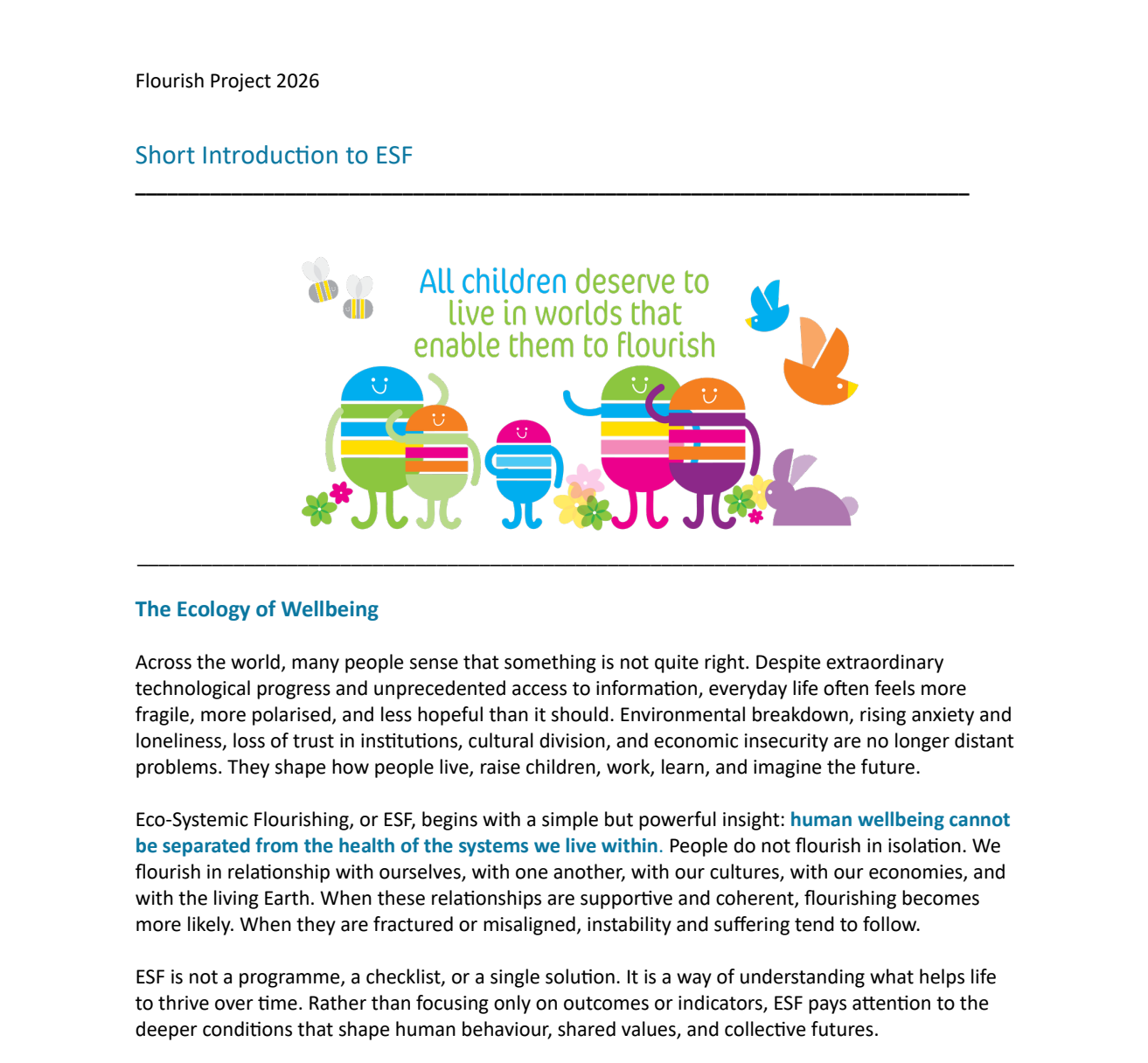
Short Introduction to ESF.pdf

The document introduces Eco-Systemic Flourishing (ESF), a framework emphasizing that human wellbeing is deeply connected to the health of the systems we live in. It identifies current global issues—like environmental degradation, anxiety, and social division—as signs of systemic failure. ESF outlines seven ongoing human needs: security, relationship, independence, engagement, fulfilment, contribution, and growth, which shape interactions with self, others, and the world. The importance of early development is highlighted, as early experiences influence wellbeing across generations. ESF describes four essential, interconnected domains for flourishing: human capacities and potential, cultural values and identity, the natural environment, and circular/regenerative economics. The framework promotes a holistic perspective, noting that misalignment in one domain can destabilize others, while coherence fosters resilience. ESF is not a prescriptive program but a lens for understanding and improving the systems that shape humanity, relationships, and the environment, advocating for the design of systems that support development, relationships, and the living world.

Download Resource
Powerpoint
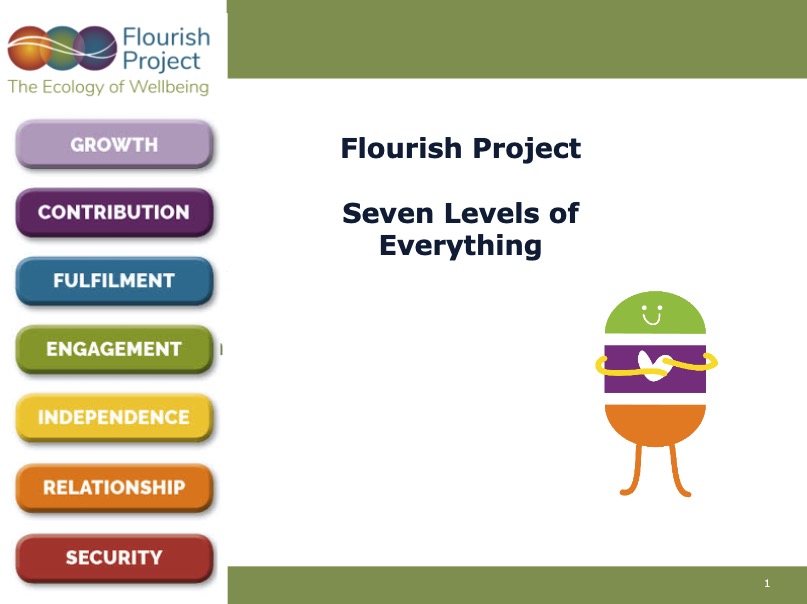
Seven Levels of Everything
The document outlines the Flourish Project's 'Seven Levels of Everything' model, a holistic framework for wellbeing applicable to individuals, communities, schools, and care settings. The seven levels—Growth, Contribution, Fulfilment, Engagement, Independence, Relationship, and Security—are each explored through reflective questions and linked to practical needs and resources for different groups. The model emphasizes human rights, personal and community development, emotional and physical health, and environmental sustainability. It connects to international wellbeing measures, educational competencies, and care frameworks, highlighting values such as empathy, resilience, creativity, inclusiveness, and safety. The document also provides examples of community resources, wellbeing apps, and care approaches (including Montessori and dementia care) that align with the seven levels, aiming to support holistic flourishing across all life stages and societal levels.
Download Resource
Word Document
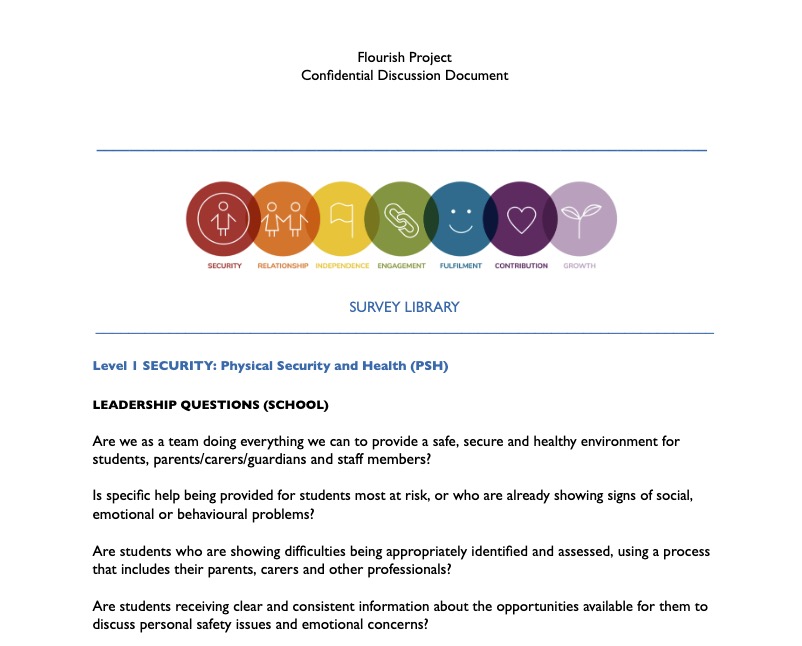
Digital Wellbeing Platform - Survey Library
The document is a survey library for schools aimed at assessing and promoting wellbeing among students, staff, parents/carers/guardians, and leadership. It is organized around seven key themes: Security, Relationship, Independence, Engagement, Fulfilment, Contribution, and Growth. Each theme includes targeted questions for different stakeholders to evaluate experiences and perceptions related to safety, mental health, relationships, self-worth, engagement, fulfilment, participation, and sense of purpose. The purpose is to help schools identify strengths and areas for improvement in wellbeing, fostering a supportive and inclusive environment for the entire school community.
Download Resource
Word Document
The ESF Wellbeing Evaluation Grades
The document describes the Eco-Systemic Flourishing (ESF) Grading System, which assesses wellbeing frameworks based on two main criteria: the depth of human motivation (across seven levels) and the breadth of ecosystemic integration (across four domains: Human Capacities & Potential, Cultural Values & Identity, Natural Environment, and Circular & Regenerative Economics). Frameworks are evaluated on five dimensions—Motivational Depth, Domain Breadth, Relational Integration, Ecological Consciousness, and Transformative Potential—each scored from 0 to 5, for a maximum of 25 points. Grades range from A (fully integrated, eco-systemic) to E (minimal integration). The system is applied to various frameworks, noting that Nova Scotia Community Wellbeing scores highly for participatory and ecological integration, while British Columbia Health Indicators is strong in basic needs but lacks growth and ecological focus. The document emphasizes the value of participatory, adaptive, and ecological approaches for higher ESF grades and suggests Nova Scotia could serve as a global model with further improvements.
Download Resource
Word Document
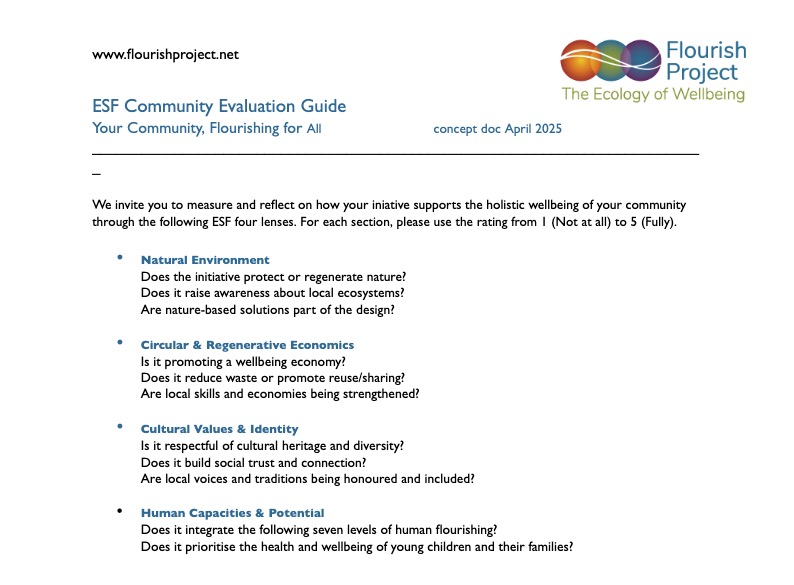
ESF Community Evaluation Guide
The ESF Community Evaluation Guide outlines a framework for assessing community initiatives through four key lenses: Natural Environment (focus on nature protection, ecosystem awareness, and nature-based solutions), Circular & Regenerative Economics (emphasizing wellbeing economies, waste reduction, and support for local skills and economies), Cultural Values & Identity (highlighting heritage, social trust, and inclusion of local voices), and Human Capacities & Potential (covering physical health, emotional safety, agency, meaningful activities, self-expression, participation, and intergenerational learning). The guide recommends rating each area from 1 to 5 to evaluate the initiative's overall impact on holistic community wellbeing.
Download Resource