The Wisdom Lab

The Wisdom Lab is an Innovation Lab dedicated to safeguarding the core principles that sustain life and ensuring they remain active, visible, and protected across all Flourish Project Labs.

About this Lab:

The Wisdom Lab is an Innovation Lab dedicated to safeguarding the core principles that sustain life and ensuring they remain active, visible, and protected across all Flourish Project Labs.

Across human history, ancient and Indigenous cultures have recognised that flourishing arises not from domination, extraction, or speed, but from right relationship - with self, community, the living Earth, and future generations. These cultures understood life as relational, cyclical, and reciprocal, governed by principles such as care, balance, responsibility, humility, and respect for limits.

The Wisdom Lab exists to carry these principles forward into contemporary systems, ensuring that innovation across education, governance, economics, media, and technology remains aligned with what sustains life rather than undermines it.

At its heart, the Lab recognises wisdom as a developmental and relational capacity, not a static body of knowledge. Wisdom emerges when human beings learn to:

  • hold complexity without fragmentation
  • act with care for long-term consequences
  • honour interdependence across human and more-than-human systems
  • align values, decisions, and action over time

These capacities were once cultivated through story, ceremony, apprenticeship, and close relationship with land and community. Today, they must be consciously re-integrated into modern institutions and innovation processes if flourishing futures are to remain possible.

A keystone Lab for the whole ecosystem

The Wisdom Lab plays a unique role within the Flourish Project ecosystem. It functions as a keystone Lab, helping to ensure that all other Innovation Labs remain anchored to life-affirming principles, including:

  • reciprocity rather than extraction
  • responsibility rather than entitlement
  • regeneration rather than depletion
  • participation rather than domination
  • continuity across generations rather than short-term gain

In this way, the Wisdom Lab does not compete with other Labs. It supports their ethical coherence, helping innovation remain in service of life rather than detached from it.

Core areas of inquiry

The Wisdom Lab focuses on:

  • Intergenerational responsibility, ensuring future generations are treated as present moral stakeholders
  • Ecological belonging, recognising humanity as embedded within living systems, not separate from them
  • Cultural memory and meaning, preserving wisdom traditions that have sustained communities over millennia
  • Wise governance and systems design, oriented toward long-term wellbeing rather than short-term optimisation
  • Inner development as shared infrastructure, recognising that ethical action arises from developmental conditions shaped early in life and reinforced through culture

Grounded in the Eco-Systemic Flourishing (ESF) Framework, the Wisdom Lab integrates human development, cultural values, ecological integrity, and regenerative economics into a coherent approach to innovation and stewardship. In a world of accelerating change, the Wisdom Lab exists to hold a steady centre - ensuring that progress remains accountable to the conditions that make life possible.

Core Principles

Unity in Kinship
Affirming our existence in a universal web of interbeing, where the
flourishing of humanity depends on a positive relationship with all species
within a living, evolving, and unitive Cosmos

Stewardship and Care
Promoting wholistic stewardship models that embody the wisdom of
nature's evolutionary dynamics and embrace an ethic of care
to ensure the flourishing of future generations and all Life

The Convergence of Science and Spirituality
Converging ancient and Indigenous teachings with leading-edge
science and technologies to promote a unitive worldview
that is foundational to our way forward

Creativity and Storytelling
Honouring the importance of the creative arts and storytelling
for envisioning a new world and facilitating intercultural,
interspecies and intergenerational learning

Collective Healing
Promoting cross-cultural, interspecies and planetary healing,
together with global social witnessing, as essential for the
creation of peaceful and compassionate human societies

Radical Collaboration
Facilitating transformational collaboration and coherence across
diverse disciplines to harness and amplify actions
that shape a world of peace, love, and unity.

Emergence
Advancing our co-evolution through a whole systems relational
approach that is adaptive to the needs of our time

Love in Action
Ensuring that human activities across all aspects of life reflect
the best of human values and behaviours and have
a net positive impact on future generations
Button
Resources

Open Resources for Change

PDF
Introducing the ESF Framework - Flourish Project, Sept 2025 .pdf

The document introduces the Eco-Systemic Flourishing (ESF) Framework, a holistic model for human and planetary wellbeing that addresses interconnected crises like climate change, social fragmentation, and mental health decline. The ESF Framework redefines flourishing as a dynamic, relational, and developmental process, integrating systems theory, Indigenous knowledge, developmental psychology, and ecological ethics. It features a four-domain matrix (Natural Environment, Circular & Regenerative Economics, Cultural Values & Identity, Human Capacities & Potential) and a seven-level model of human motivation. The framework emphasizes interdependence, moral development, and spiritual ecology, critiquing reductionist and anthropocentric wellbeing models. It is designed for practical application in education, governance, policy, and communities, offering tools for assessment and systems literacy. The document highlights the importance of early childhood in shaping worldviews, the need for education that fosters relational and ecological awareness, and addresses challenges like empirical validation and cultural adaptation. The ESF Framework is presented as a living, adaptable tool for regenerative societal transformation, aiming to unite inner development with systemic change for long-term flourishing.

Download Resource
PDF
Short Introduction to ESF.pdf

The document introduces Eco-Systemic Flourishing (ESF), a framework emphasizing that human wellbeing is deeply connected to the health of the systems we live in. It identifies current global issues—like environmental degradation, anxiety, and social division—as signs of systemic failure. ESF outlines seven ongoing human needs: security, relationship, independence, engagement, fulfilment, contribution, and growth, which shape interactions with self, others, and the world. The importance of early development is highlighted, as early experiences influence wellbeing across generations. ESF describes four essential, interconnected domains for flourishing: human capacities and potential, cultural values and identity, the natural environment, and circular/regenerative economics. The framework promotes a holistic perspective, noting that misalignment in one domain can destabilize others, while coherence fosters resilience. ESF is not a prescriptive program but a lens for understanding and improving the systems that shape humanity, relationships, and the environment, advocating for the design of systems that support development, relationships, and the living world.

Download Resource
Powerpoint
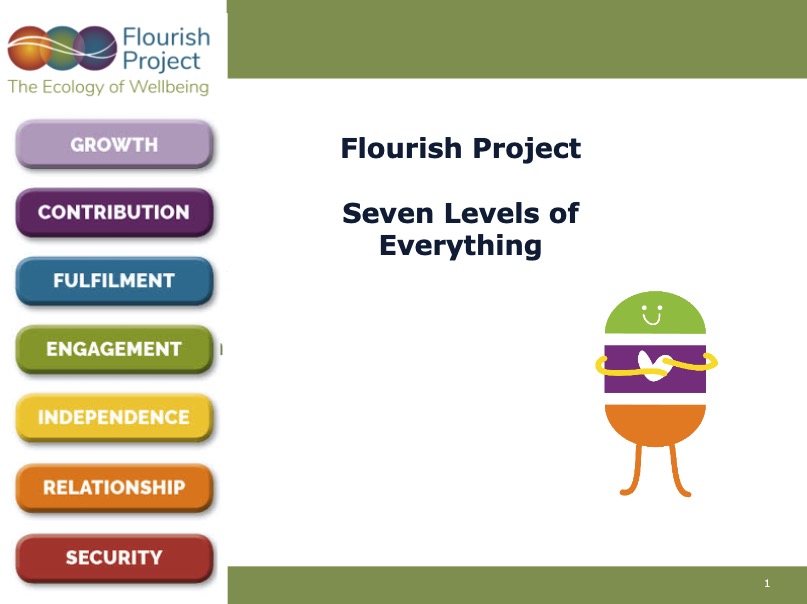
Seven Levels of Everything
The document outlines the Flourish Project's 'Seven Levels of Everything' model, a holistic framework for wellbeing applicable to individuals, communities, schools, and care settings. The seven levels—Growth, Contribution, Fulfilment, Engagement, Independence, Relationship, and Security—are each explored through reflective questions and linked to practical needs and resources for different groups. The model emphasizes human rights, personal and community development, emotional and physical health, and environmental sustainability. It connects to international wellbeing measures, educational competencies, and care frameworks, highlighting values such as empathy, resilience, creativity, inclusiveness, and safety. The document also provides examples of community resources, wellbeing apps, and care approaches (including Montessori and dementia care) that align with the seven levels, aiming to support holistic flourishing across all life stages and societal levels.
Download Resource
Word Document
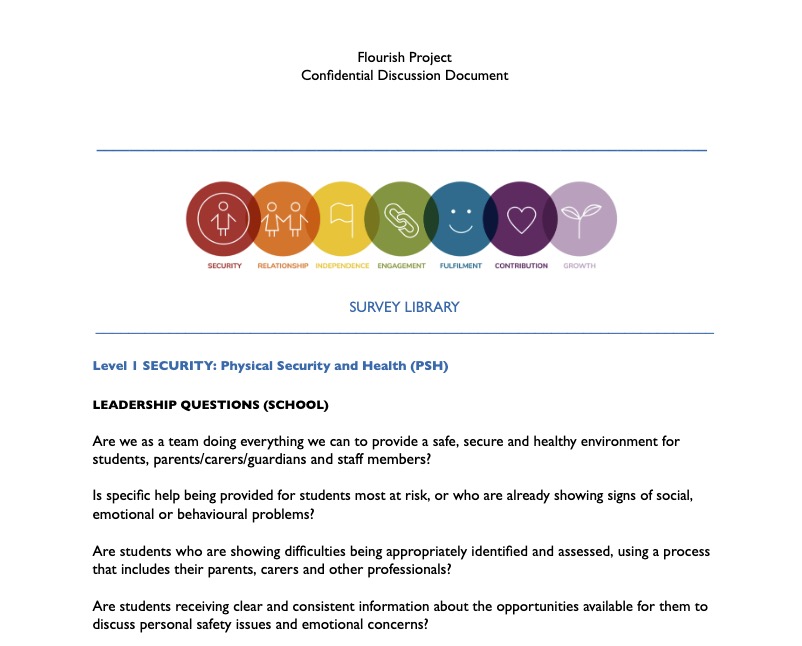
Digital Wellbeing Platform - Survey Library
The document is a survey library for schools aimed at assessing and promoting wellbeing among students, staff, parents/carers/guardians, and leadership. It is organized around seven key themes: Security, Relationship, Independence, Engagement, Fulfilment, Contribution, and Growth. Each theme includes targeted questions for different stakeholders to evaluate experiences and perceptions related to safety, mental health, relationships, self-worth, engagement, fulfilment, participation, and sense of purpose. The purpose is to help schools identify strengths and areas for improvement in wellbeing, fostering a supportive and inclusive environment for the entire school community.
Download Resource
Word Document
The ESF Wellbeing Evaluation Grades
The document describes the Eco-Systemic Flourishing (ESF) Grading System, which assesses wellbeing frameworks based on two main criteria: the depth of human motivation (across seven levels) and the breadth of ecosystemic integration (across four domains: Human Capacities & Potential, Cultural Values & Identity, Natural Environment, and Circular & Regenerative Economics). Frameworks are evaluated on five dimensions—Motivational Depth, Domain Breadth, Relational Integration, Ecological Consciousness, and Transformative Potential—each scored from 0 to 5, for a maximum of 25 points. Grades range from A (fully integrated, eco-systemic) to E (minimal integration). The system is applied to various frameworks, noting that Nova Scotia Community Wellbeing scores highly for participatory and ecological integration, while British Columbia Health Indicators is strong in basic needs but lacks growth and ecological focus. The document emphasizes the value of participatory, adaptive, and ecological approaches for higher ESF grades and suggests Nova Scotia could serve as a global model with further improvements.
Download Resource
Word Document
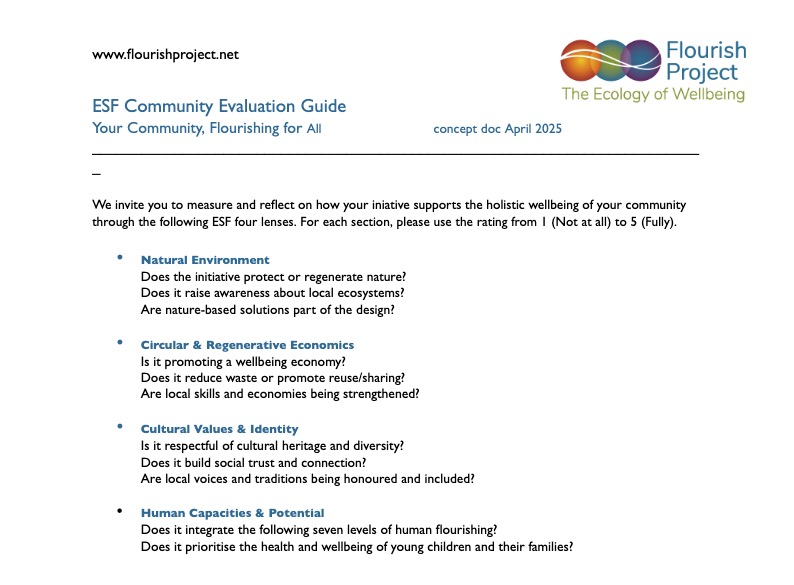
ESF Community Evaluation Guide
The ESF Community Evaluation Guide outlines a framework for assessing community initiatives through four key lenses: Natural Environment (focus on nature protection, ecosystem awareness, and nature-based solutions), Circular & Regenerative Economics (emphasizing wellbeing economies, waste reduction, and support for local skills and economies), Cultural Values & Identity (highlighting heritage, social trust, and inclusion of local voices), and Human Capacities & Potential (covering physical health, emotional safety, agency, meaningful activities, self-expression, participation, and intergenerational learning). The guide recommends rating each area from 1 to 5 to evaluate the initiative's overall impact on holistic community wellbeing.
Download Resource